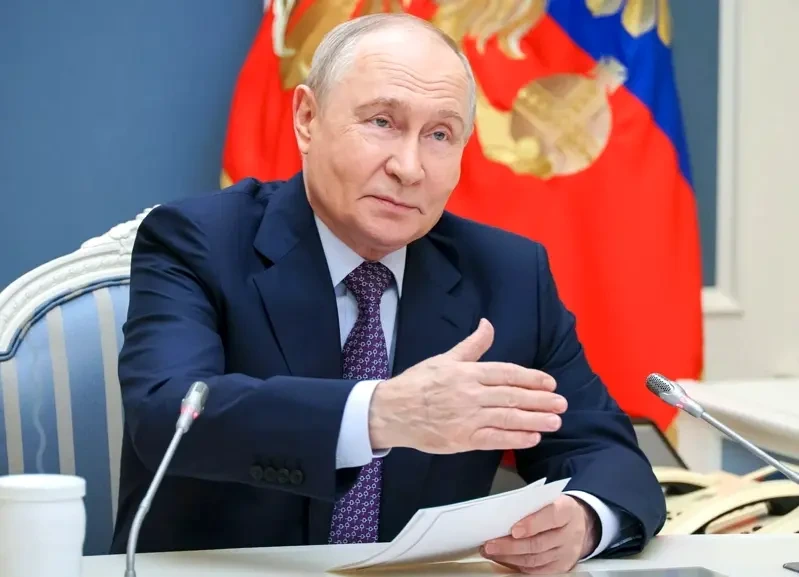
Russian President Vladimir Putin has reportedly proposed a meeting next month with U.S. President Donald Trump and Chinese leader Xi Jinping to discuss ending the Russia-Ukraine war—a proposal that would exclude both Ukraine and Europe. The Wall Street Journal notes that an arrangement in which three major powers deliberate on the fate of another nation could deepen concerns in Taiwan: could its own future one day be decided in negotiations from which it is excluded? As of now, Trump has not agreed to the meeting, and neither the timing nor the agenda has been finalized.
Citing people familiar with the matter, the Wall Street Journal reported that Putin floated the idea of a three-way summit during a phone call with Trump on October 9, suggesting it take place on the sidelines of the APEC summit in Shenzhen, scheduled for November 18–19. Senior U.S. officials indicated that, given Trump’s desire to fulfill his campaign promise to end the war, he might be open to considering the proposal.
Kremlin spokesperson Dmitry Peskov confirmed that discussions are underway, though no final decisions have been made regarding whether the meeting will take place or what its agenda might be. He noted that all three parties acknowledge the possibility of such a meeting.
According to those familiar with the situation, Russia also reached out to Beijing through diplomatic channels; China indicated that it would not object, provided that Trump agrees. The White House and the Chinese Embassy in the U.S. did not respond to requests for comment.
A former Russian intelligence official familiar with the matter suggested that Putin envisions this three-way summit as a “second Yalta”—a forum to carve up global spheres of influence. While such an ambition may be unrealistic—and not necessarily welcomed by Trump or Xi—the prospect of the three leaders deliberating on the fate of Ukraine could unsettle Taiwan, raising fears that its own future might one day be the subject of similar negotiations.
For Putin, such an arrangement would not only solidify Russia’s status as a global power but also sideline Europe—which Moscow views as an obstacle to its victory in Ukraine. Should the meeting go forward, it would elevate Beijing’s diplomatic profile, though it could also trigger a backlash from Europe due to China’s more direct involvement in the Russia-Ukraine conflict.
This proposal comes at a time when U.S.-Russia relations appear to be warming, while U.S.-Ukraine relations have sunk to a new low. Donald Trump recently agreed to hold off on tightening sanctions against Russia in exchange for Russian diesel supplies—a move intended to help lower oil prices—which has drawn backlash from some fellow Republicans. Trump stated that he does not want to push Vladimir Putin away from the negotiating table.
In an interview with Bloomberg on Sunday, Ukrainian President Volodymyr Zelenskyy accused the U.S. of deliberately throttling Starlink internet speeds and delaying the delivery of air-defense missiles—actions he suggested appear aimed at forcing Ukraine to surrender. “I don’t want to believe that our American partners think they can sacrifice Ukraine to bring the war to an end sooner,” he said. “But that is what it looks like.”
Zelenskyy proposed that Ukraine could halt its strikes on Russian oil refineries in exchange for additional Patriot air-defense missiles to protect its own energy infrastructure; however, he noted that the U.S. side merely demanded that Ukraine cease its attacks. He further alleged that the U.S. has withheld some interceptor missiles that Ukraine had already paid for, asserting that “this is not a technical issue.”
On Sunday, Trump took to social media to claim that Zelenskyy is unwilling to end the war, arguing that Ukraine could have secured better terms two years ago. Trump had previously urged Ukrainian forces to stop attacking Russian oil refineries and even hinted that Ukraine might need a change in leadership.
Both Russia and Ukraine continue to target each other’s energy infrastructure. Ukrainian officials reported that Russian strikes on electrical substations over the weekend left tens of thousands of households without power, while fires broke out at facilities including an oil terminal in St. Petersburg, Russia. On Sunday evening, Kyiv was struck by Russian ballistic missiles, resulting in at least one death.
发送反馈