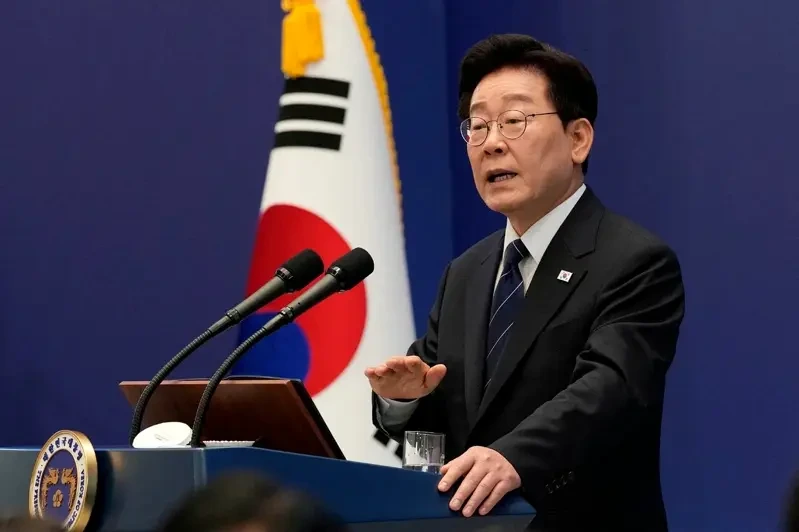
During a press conference held at the Blue House Guest House on the 18th, South Korean President Lee Jae-myung addressed the issue of deploying troops to the Strait of Hormuz, stating, “We will not dispatch troops to intervene or participate in the war.”
According to a report by the JoongAng Ilbo, Lee emphasized, “We will not deploy troops to participate in or intervene in the war, nor will we send military equipment.” He added, “We have adhered to this principle thus far, and it will not change in the future.”
On August 19, President Trump criticized South Korea for its reluctance to assist the U.S. in maintaining security in the Strait of Hormuz, noting that approximately 60% of South Korea’s oil is transported through the area. He had asked Lee Jae-myung if South Korea was willing to help, only to receive a “no, thank you” response. South Korea’s Dong-A Ilbo reported in early September that the Trump administration subsequently pressured Seoul to quickly decide on troop deployment, stating that it was “awaiting South Korea’s support.”
The Dong-A Ilbo noted that South Korea was considering a deployment plan focused on non-combat missions—such as P-8 maritime patrol aircraft, military logistics support ships, and an Explosive Ordnance Disposal (EOD) team from the Navy Special Warfare Flotilla—to respond to the U.S. request while avoiding direct involvement in a war.
The issue of troop deployment also sparked division within South Korea’s ruling camp. One faction argued that deployment might be unavoidable given national interests, while another worried it could be perceived as participation in a war against Iran; others questioned the legitimacy of the deployment and whether the practical benefits justified it.
In response, Lee Jae-myung stated, “It is clear that, like other nations, we must take minimal action to protect our commercial vessels, crude oil shipping lanes, and the lives and safety of our citizens.” He added that the South Korean Navy’s anti-piracy unit was already stationed in the region to prevent and respond to threats—including piracy—posed to shipping lanes and the safety of citizens.